
Everybody Has a Tip. Nobody Shares a Process.

In my last post (I Spent Ten Years Saying I Wanted to Noseride), I shared how I spent over a decade wishing I could noseride. Buying the wrong equipment. Wasting $250 on a coach who never actually taught me anything. Collecting tip after tip that got me nowhere.
The Noseride Blueprint, our program here at The Surf Société, changed all of that.
You can read the whole thing here, but you don't need it to follow this one.
Prefer to listen? I read this one on the podcast. Press play, or keep scrolling.
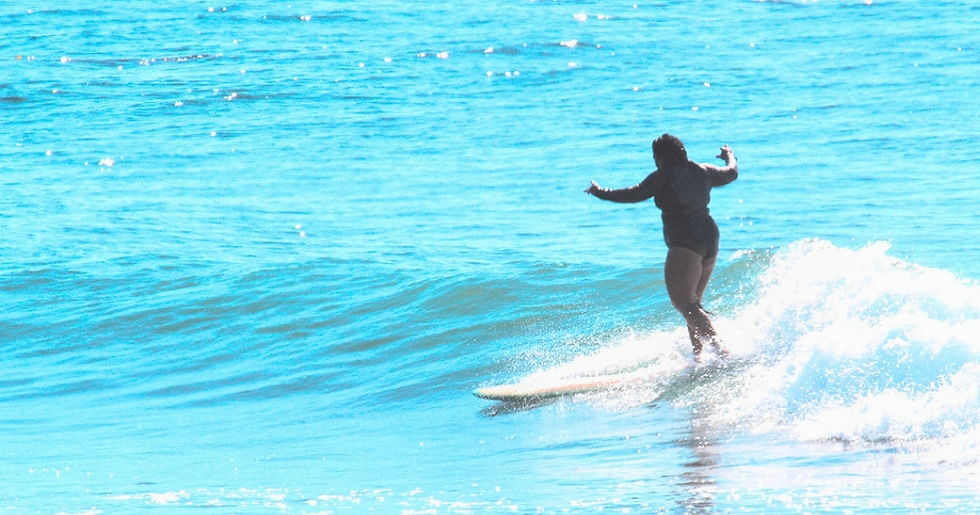
A guy commented on my Instagram recently. I had posted about the 8'6" surfboard a surf shop sold me when I told them I wanted to learn how to noseride. At the time, I didn't know any better, I was still pretty new to surfing. I later realized the board I took home wasn't actually ideal for noseriding.
He wrote: "It depends on the wave rather than the board. Some waves don't pitch up enough, making noseriding hard."
That's it. That was the advice.
As if I was supposed to understand it and apply it right then and there, on a board that wasn't right for my goal in the first place.

And it's not just him. I have screenshots of comments saying the same and similar.
"Slow yourself down and wedge your board into the lip, especially the back end."
"Find the radical steep section where the pocket and the water flows over the tail, pushing down and creating lift."
They're not wrong. They're actually all correct.
How Is Noseriding Even Possible?
If you want to noseride, the first thing you need to know is how it's possible.
I'll give you a quick lesson now. Here's the long and the short of it:
Your goal in noseriding is to position the tail of your board into the wave in such a way that the wave topples over the back of the board. That weight holds the board down and gives you the leverage to run up to the front of it and thus complete the noseride.

Even if this is brand new information to you right now, this is just the beginning of understanding noseriding.
Once you grasp this visual, it's easy to reply to all the above advice with "well... duh."
It's okay if you're not reaching for the "duh" as fast as I am, and you don't feel that way about this advice yet. That's actually the point I'm trying to make.
Piling on another piece of ubiquitous advice about noseriding can leave you wondering, why can't I do this?
If it was as easy as "you say, I do," we'd all be cross-stepping and hanging 10 by now.
What Gets Lost in the Mansplaining
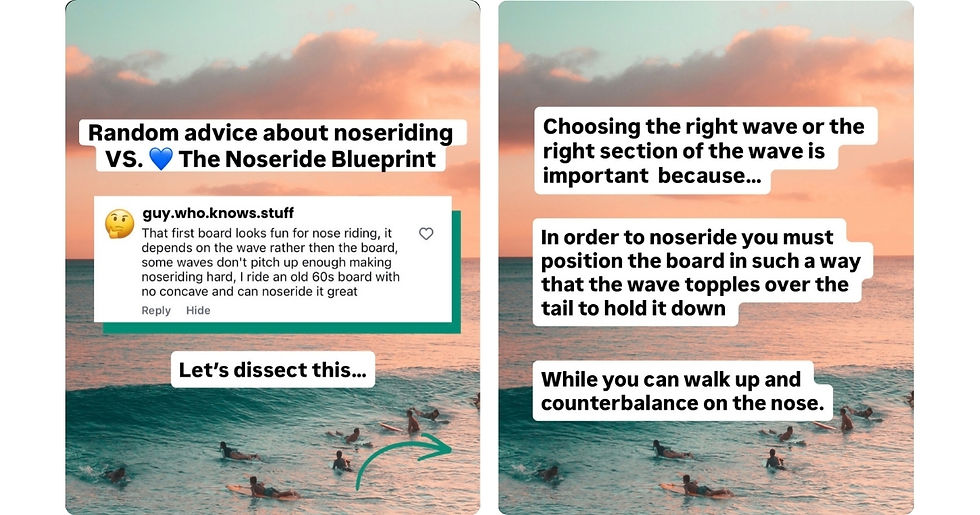
I responded to these comments in a post on my IG with a breakdown.
Here's the level of process that gets lost in the mansplanation:
Not all waves are ideal for noseriding. But certain waves and sections are more common to noseride, and easier than others.
Choosing the right wave, or the right section of the wave, is important because in order to noseride, you have to position the board in such a way that the wave topples over the tail and holds it down. Then you can walk up and counterbalance on the nose. (You know this now!)
So yes, "a wave that pitches up enough" can create an ideal noseride scenario. But knowing that alone doesn't get you noseriding.
There are many different strategies to set your board up for a noseride, and the strategy you use will depend on a few factors.
Your position in relation to the wave or section you want to noseride.
The wave shape.
Your ability level
And here's where the Noseride Blueprint comes in.
In the Noseride Blueprint, you'll learn:
The different strategies to set up a noseride,
What wave shapes and characteristics pair best with which strategies and
What strategies work best for the types of waves you surf and your current ability level.
I know, that's a lot of information, and it's okay if you don't understand all of it yet. That's actually what I wanted to demonstrate. All of this depth sits nuanced and unexplored behind the "just find a pitchy wave" tip.
The Noseride Blueprint is the roadmap. You get to come in and personalize it. Figure out where you are in the process and, with the help of the community, know what to work on next. On your way, you build your own process for working toward the nose. You're no longer guessing or picking up random tips. Now you're progressing.
That's what the Noseride Blueprint is for.
Everybody has a tip. Nobody shares a process. Until the Noseride Blueprint.

Who Are We Learning From?
So if we're not collecting advice from random bros on Instagram, who are we learning from?
The advice I trust most comes from people who've surfed many different breaks on many different surf craft, and have spent a lot of time in the water but even more time thinking deeply about surfing.
It shows in their answers. They will never leave you with advice that begs you to figure it out on your own. Instead, they'll ask you more questions before they speak. They'll pause before they answer, because they're actually considering your situation instead of blurting out some generic rule.
And sometimes they'll leave you with an eloquent one-liner that will make you really think about your surfing.
You'll know you've run into a good mentor when you ask a question and with conviction they will say "never say never," because that means they've had enough experience to know that surfing can be an infinite combination of things.
Meet a few of your mentors from The Noseride Blueprint

Erin Meza-Ashley aka 'Worm' started surfing in her 20s with no one to look up to, and no preconceived notion of what surfing was supposed to look like. She came out with her own style. You'll see her setting up stylish hang tens and cheater fives. Worm is also a longboard judge and the mentor who will teach how to make noseriding your own.
Our favorite advice from Worm right now: Get in the reps. Don't get bogged down by the process. Just know that the process Is the process. Keep working, keep going after your goal, and you'll get there.

Paul Spooner is the surf dad you never had. He's a board builder and shaping instructor, a lifelong surfer who figured it all out. Paul is incredibly articulate when it comes to surfing. Explain what you're struggling with and he will relay a solution back to you.
Our favorite advice from Paul right now: Pre-knowledge is good for your brain. It's okay if the Information feels like a lot right now. Learning something before you're ready for it primes your brain for the scenarios you'll run into later, so when they happen, you recognize them, build on them, and already know where to go to find what you need.
Side note if you're wondering if The Noseride Blueprint is right for you: If you're working toward your first cross-step knowledge about Hanging 5 and Hangiang 10 Is still valuable to you. ,That's why we built the blueprint like a roadmap. So you know where you are and where you're going.

Tessa is our cross-step coach. She's a competitive surfer, amazing at noseriding, and better than almost anyone at breaking down cross-step drills into something you can actually put into practice on land and in water.
Our favorite advice from Tessa right now: "Most people can probably get up there, they just don't know it, because they've never actually tried. It's a trial-and-error process. You have to go try it."
These aren't just people you learn from. They're people you have a conversation with.
The process of learning to noseride isn't someone talking at you, telling you what to do. It's you engaging with it, trying what they suggested, and coming back to the conversation to share what you found.
And we're always adding more mentors and more voices to that conversation.
Inside the Noseride Blueprint

The Noseride Blueprint is a challenge where we get together to demystify noseriding.
Six workshops that teach mindset, equipment, wave and section selection, cross step technique, hang five, and hang ten plus advanced maneuvers.
Guided Q&As that extend the conversation and go more in depth.
Practical assignments, easy to follow, so you're actually doing the things, on land and in the water, with real in-water drills, so you know exactly what to focus on
In water drills that meet you where you're at so you know exactly what to focus on when you paddle out.
A community to bring your wins, your struggles, and your questions to.
A Process That Actually Gets You That First Cross-Step and Noseride
You attend a workshop. You learn something. You do the assignments and the in-water drills. You go surf. You learn from that. You collect information. You come back and share it with the community, get feedback there, and bring your questions to the next guided Q&A. Then you go out and try again. That's the Noseride Blueprint process.
Every woman who's gone through the Blueprint ends up finding a version of that cycle that works for her. Her own way of taking in the information, working with it, bringing it back, and pushing herself forward.
You're no longer confined to piecemealing tips off random YouTube videos and Instagram comments from guys who've never seen you surf. You have a roadmap. You have a blueprint. You have the knowledge, the mindset, and the support to chase your noseride goals and actually make progress.
Everybody has a tip. Nobody shares a process. Until the Noseride Blueprint.

Is the Noseride Blueprint Right for Me?
If you love longboarding and want to get technical about it, yes.
Skill level:
You can catch green waves and go down the line but have never cross-stepped before
Or you can take a few cross-steps and want to close the gap to the nose
Or you can make it to the nose occasionally but want to improve your setup, finesse your style, and become more intentional
Wherever you are, your assignments meet you there, so you're always working toward the next step.

Come Build Your Process With Us
You don't have to keep piecing together tips from strangers. You don't have to guess for another decade.
Enrollment for the Noseride Blueprint is open now. We start August 18, and a payment plan is available. Join the Noseride Blueprint here.
If you'd rather start with something free first, download the Noseride Guide.

Comments